

Why Production Planning Matters More Than Creative Talent
Why Production Planning Matters More Than Creative Talent
In the competitive landscape of the Mississippi Gulf Coast, businesses often believe that the success of a creative project rests solely on the artistic talent of the provider. While aesthetic skill is necessary for high quality outcomes, it is rarely the deciding factor in whether a project succeeds or fails. For retail and hospitality businesses in Biloxi, Gulfport, and Long Beach, the primary driver of success is production planning. This discipline involves the meticulous sequencing of tasks, the management of technical dependencies, and the enforcement of a strict approval process. Without these structural elements, even the most visually stunning project can become a liability characterized by missed deadlines and unfulfilled objectives.
Creative talent provides the raw materials, but production planning provides the architecture. When a project is properly planned, every action is intentional and every resource is allocated efficiently. This approach ensures that the final product is not just attractive but also functional and reliable. For a professional services firm, reliability is more valuable than artistic flair. A website that looks beautiful but fails to function during a peak tourism season on the coast is a failure. Therefore, the focus must remain on the logistical framework that supports the creative work.
The Strategic Importance of Project Sequencing
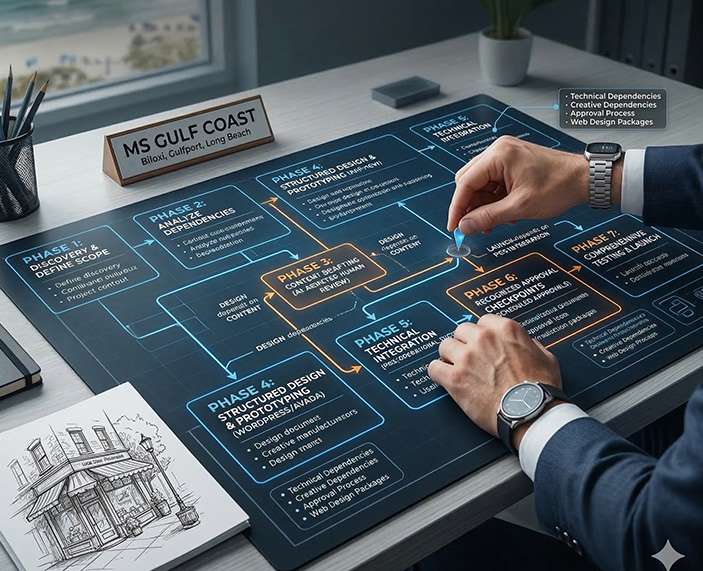
Project sequencing is the process of determining the exact order in which tasks must be performed to ensure maximum efficiency. In a professional production environment, work cannot happen in a random order. Each phase of a project builds upon the previous one. For hospitality businesses, such as hotels or local restaurants, sequencing is particularly critical because their digital assets must often integrate with physical operations. If the sequencing is flawed, the project will inevitably encounter friction that leads to delays.
A structured sequence allows for the logical progression of ideas into technical reality. This is part of the established methodology at WONGA Studios, which is described in detail within the section titled How We Work. By following a set sequence, the studio ensures that the foundation of a project is solid before any decorative elements are added. This prevents the need for costly rework later in the process. When a retail business understands the sequence, they can better prepare their internal teams for the necessary inputs at each stage.
Logical Progression in Retail and Hospitality
In the retail sector, a digital project may involve various components like inventory management systems or point of sale integrations. These technical requirements must be addressed before the creative design phase begins. Sequencing ensures that the website architecture can support the necessary business systems. If a designer begins creating layouts before the technical requirements are defined, the resulting design may not be compatible with the required functionality. This leads to a situation where the creative talent is wasted on concepts that cannot be implemented.
For hospitality businesses, the sequence often begins with defining the user journey. Understanding how a guest will book a room or view a menu is the first step. Only after this journey is mapped can the creative work begin. By prioritizing the user experience and technical requirements over initial visual concepts, the project remains grounded in practical business needs. This logical progression is a hallmark of professional production planning.
Managing Technical and Creative Dependencies
A dependency is a task that cannot start until another task is finished. Understanding these dependencies is the core of effective production planning. Every creative project is a web of interconnected tasks. For example, website and blog content creation cannot be finalized until the site architecture is approved. Similarly, motion graphics cannot be rendered until the brand style guide is established. Managing these links requires a deep understanding of the professional creative process.
The Services Overview provided by WONGA Studios lists a wide range of business-focused solutions, each with its own set of internal and external dependencies. A successful project manager identifies these links early and schedules work to ensure that no specialist is waiting on another. This foresight prevents bottlenecks that often plague less disciplined studios. When dependencies are managed correctly, the project moves forward in a continuous, predictable flow.
Dependencies within Web Design Packages
When a business selects one of the established Web Design Packages, they are entering a system designed around specific dependencies. These packages are structured to provide a predictable outcome within a set timeframe. Each step in the package is dependent on the completion of the previous step. For instance, the mobile optimization phase cannot begin until the desktop layouts are finalized and approved.
If a client requests a change that violates these dependencies, it disrupts the entire production line. This is why production planning is more important than creative talent alone. A talented designer might be able to create a new layout quickly, but if that layout breaks the established technical dependencies, the project will stall. Planning ensures that all creative additions are evaluated for their impact on the technical requirements of the package.
The Role of Scheduled Approvals in Project Success
Approvals are the checkpoints that protect the project from drifting off course. A disciplined production plan includes scheduled approvals at critical junctures. These milestones ensure that the client and the studio remain in total alignment throughout the execution phase. For retail businesses that operate with tight margins and specific seasonal goals, these approvals are essential for maintaining the project timeline.
An approval is not just a formality; it is a commitment to the work completed to date. Once a phase is approved, the project moves to the next stage, and the previous work is locked in. This prevents the cycle of endless revisions that often occurs when a project lacks a formal planning structure. By adhering to a strict approval schedule, the studio protects the client’s budget and ensures that the final delivery date is met.
Avoiding Unscheduled Revisions and Rework
Unscheduled revisions are the primary enemy of production planning. They often occur when a project lacks clear definitions or when the approval process is not enforced. Creative talent can sometimes lead to a desire for perfection that results in constant tweaking. However, in a professional business environment, “finished” is better than “perfect” if “perfect” means the project is never delivered.
Production planning sets the boundaries for creative exploration. It allows for high level creative work within a defined window of time. Once that window closes and an approval is granted, the project moves on. This discipline is what allows WONGA Studios to maintain high standards across multiple projects simultaneously. It also allows for the integration of Option Add-Ons in a controlled manner, ensuring that new features do not jeopardize the core project.
AI-Assisted Content and Production Efficiency
Modern production planning also involves the strategic use of advanced tools. WONGA Studios utilizes AI-assisted drafting for various content requirements. This technology allows for the rapid generation of initial structures and drafts, which are then subjected to rigorous human review and editing. Framing AI as a production tool rather than a creative replacement is essential for maintaining professional standards.
The use of AI in this capacity is a planning decision. It allows the studio to allocate more time to high level strategy and final refinement. By using AI to handle the initial heavy lifting of content structure, the principal can focus on ensuring the content aligns perfectly with the client’s business goals and the broader Content Strategy. This human-led oversight ensures that the efficiency of AI does not come at the expense of quality or accuracy.
Strategic Planning for Regional Growth
For businesses on the Mississippi Gulf Coast, growth requires a reliable digital foundation. Whether a company is in the hospitality industry or a professional services sector, their digital assets must be scalable and robust. Production planning ensures that this scalability is built into the project from day one. It considers the long-term needs of the business, such as Search & Visibility, and ensures that the current work supports future growth.
Creative talent is the engine that drives a project, but production planning is the steering wheel and the brakes. It ensures the engine is used effectively and that the project reaches its destination safely and on time. By prioritizing planning over talent alone, WONGA Studios delivers results that are predictable, professional, and perfectly aligned with the needs of the Mississippi Gulf Coast business community. This disciplined approach is what defines a successful technical and creative partnership.
Let’s Build Something That Works for Your Business
Let’s Build Something That Works for Your Business
WONGA Studios brings years of experience across web design, motion graphics, video production, and practical IT support. We work with proven platforms and tools to create reliable, accessible solutions that support real business goals – without unnecessary complexity.