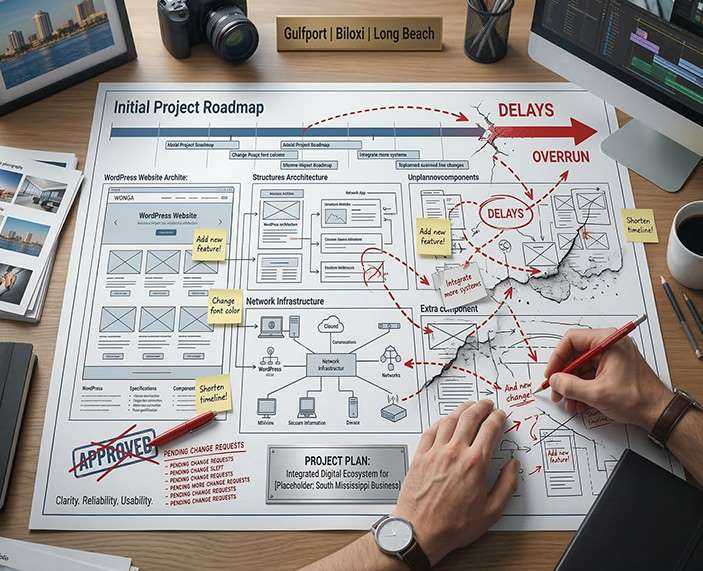

What “Defined Scope” Actually Means in a Professional Website Project
What “Defined Scope” Actually Means in a Professional Website Project
In professional website work, the phrase “defined scope” is often used but rarely understood in practical terms. Many business owners assume scope is a formality or a loose estimate that can adapt freely as ideas evolve. In reality, scope is the structural framework that determines what work is performed, how long it takes, what it costs, and who is responsible for each decision along the way.
Undefined or weakly defined scope is the single most common cause of project delays, budget overruns, and strained working relationships. This article explains how scope is established, documented, and enforced in real-world website projects, and why it exists to protect both the client and the studio.
Scope Is a Boundary, Not a Limitation
A defined scope does not restrict creativity or flexibility. It establishes clear boundaries so that progress can occur without constant renegotiation.
Scope answers four foundational questions:
- What is being built
- What is not being built
- Who is responsible for what
- How changes are handled
Without clear answers to these questions, even well-intentioned projects tend to drift. Small additions accumulate, timelines extend, and accountability becomes unclear. Defined scope creates a shared understanding that allows decisions to be made efficiently and documented properly.
This approach is central to the process outlined in How We Work, where scope is treated as an operational requirement rather than a contractual afterthought.
How Scope Is Established at the Start of a Project
Professional scope definition begins before any design or development work starts. It is not something that emerges organically during the project.
Discovery and Requirements Gathering
The first step is understanding the business objective. A website built to generate leads requires a different structure than one built to support existing clients or internal operations. During discovery, decisions are made about:
- Target audience and intent
- Core functionality requirements
- Content responsibilities
- Technical constraints and integrations
These decisions are not abstract. They directly affect page count, layout complexity, development time, and ongoing maintenance.
Translating Decisions Into Deliverables
Once requirements are understood, they are translated into concrete deliverables. This typically includes:
- Number and type of pages
- Defined functionality
- Content format and sourcing
- Approval checkpoints
- Exclusions and assumptions
This level of specificity is what separates a professional scope from a casual estimate. The Web Design Packages are structured around this principle so that deliverables are clear before work begins.
What Scope Documentation Actually Includes
Scope documentation is not a generic contract or a vague proposal summary. It is a working document used throughout the project lifecycle.
Inclusions and Exclusions
One of the most important elements of scope documentation is the explicit listing of what is excluded. Exclusions prevent misunderstandings such as assuming additional pages, integrations, or revisions are included by default.
Clear exclusions do not reduce value. They reduce ambiguity.
Timeline Dependencies
Scope defines not just what will be delivered, but when it can be delivered. Timelines are based on dependencies such as:
- Client content delivery
- Approval turnaround times
- Third-party access credentials
- Required feedback cycles
When these dependencies are delayed, the timeline adjusts accordingly. Defined scope makes these adjustments predictable rather than contentious.
Approval Structure
Professional projects include defined approval stages. These checkpoints allow work to progress without reopening completed phases. Approval means acceptance of that stage as delivered, not a placeholder for future revision.
Why Undefined Scope Causes Projects to Fail
Projects without clear scope often begin smoothly but deteriorate over time. The issues usually appear gradually rather than all at once.
Scope Creep Through Small Requests
Scope creep rarely arrives as a single large change. It appears through small requests such as adding one more page, adjusting layout behavior, or revisiting previously approved content. Individually, these requests seem minor. Collectively, they create substantial unplanned work.
Without defined scope, there is no objective way to determine whether a request is part of the original agreement or a new addition.
Budget and Timeline Erosion
When additional work is performed without adjusting scope, budgets are quietly consumed and timelines stretch without explanation. This creates frustration on both sides, even when the working relationship is otherwise positive.
Defined scope prevents this erosion by establishing a clear baseline for evaluating change.
How Change Requests Are Handled Professionally
Change is not a problem when the process for managing it is defined.
Identifying a Change Request
A change request is any request that alters the agreed deliverables, functionality, or timeline. This includes:
- Additional pages or sections
- New integrations
- Expanded content requirements
- Revisions beyond agreed limits
Recognizing a request as a change is not adversarial. It is a necessary step for maintaining project integrity.
Evaluating Impact Before Execution
Professional change management evaluates impact before work begins. This includes assessing:
- Additional time required
- Cost implications
- Timeline adjustments
- Downstream effects on other deliverables
Only after this evaluation is a change approved and incorporated into the project plan.
Documenting the Change
Approved changes are documented so that expectations remain aligned. This documentation protects both parties and ensures the project remains manageable as it evolves.
This approach aligns with broader Process & Practice principles used across structured digital projects.
Client Responsibilities Within Defined Scope
Scope does not apply only to the studio. It also defines client responsibilities that are essential to project success.
Timely Feedback and Approvals
Defined scope assumes that feedback and approvals are provided within agreed timeframes. Delays in these areas directly affect delivery schedules.
When feedback is open-ended or inconsistent, progress stalls. Clear approval criteria prevent repeated revision cycles and decision fatigue.
Content Ownership and Accuracy
Clients are responsible for the accuracy of business information, legal statements, and operational details. Even when AI-assisted drafting is used to prepare initial content, final review and approval remain a human responsibility.
Scope clarifies who supplies content, who edits it, and who approves it.
Enforcing Scope Without Conflict
Enforcing scope does not require rigid behavior or strained communication. It requires consistency.
When scope is documented clearly and referenced consistently, enforcement becomes procedural rather than personal. Decisions are based on agreed terms rather than subjective judgment.
This consistency is why defined scope is emphasized throughout How We Work and reinforced across Services Overview discussions.
Why Defined Scope Benefits Long-Term Maintenance
Scope discipline extends beyond the initial build. It influences maintenance, updates, and future enhancements.
A well-scoped project results in:
- Cleaner architecture
- Predictable maintenance needs
- Easier onboarding for future work
- Lower long-term costs
Undefined scope during the build phase often leads to fragile systems that are expensive to maintain and difficult to modify.
Conclusion: Scope Is a Professional Standard
Defined scope is not a bureaucratic requirement or a protective mechanism for studios. It is a professional standard that ensures website projects are delivered predictably, transparently, and sustainably.
For business owners, understanding scope means knowing what is being purchased, what decisions are required, and how changes are managed. For studios, it enables reliable delivery without burnout or ambiguity.
When scope is treated as a working framework rather than a formality, website projects move forward with clarity and confidence.

Let’s Build Something That Works for Your Business
Let’s Build Something That Works for Your Business
WONGA Studios brings years of experience across web design, motion graphics, video production, and practical IT support. We work with proven platforms and tools to create reliable, accessible solutions that support real business goals – without unnecessary complexity.