
What Ongoing Support Actually Means After a Website Launch
What Ongoing Support Actually Means After a Website Launch
The completion of a website project is frequently viewed by business decision-makers as the end of a process. This is understandable, given the significant resources and energy required to plan, design, and execute a modern digital presence. For professional offices on the Mississippi Gulf Coast, from medical practices to financial firms, the launch date is a milestone signifying that their investment is live and accessible to the public. However, a business-focused website is not a static product; it is a dynamic technical asset that operates within a complex, evolving online environment.
The reality is that launch day does not mark the end of responsibility but rather the transition from project development to operational management. Distinguishing between the discrete phase of a creative build and the continuous requirements of long-term maintenance is crucial for protecting this asset. This distinction is often lost in common, yet vague, terms like “ongoing support.” Without specific definitions, professional offices risk either neglecting critical technical infrastructure or having unrealistic expectations about what their service agreement actually covers. Clear boundaries are essential for long-term predictability and performance.
The Critical Distinction Between a Project and Ongoing Operations
Every professional engagement with WONGA Studios begins with a specific, defined scope. This scope is meticulously detailed, often involving a structural design process and a fixed list of deliverables. The project phase is considered complete only when these defined objectives are met, approved, and the final site is made public. The methodology of this project phase is detailed in the section describing How We Work, prioritizing structure and definition over open-ended engagements.
Once the project is closed, the professional office is now in an operational phase. The skills required to build a structured website using Avada are different from the skills required to keep that website secure, updated, and performing optimally over a multi-year period. Ongoing support is the mechanism designed to ensure the technical integrity established during the project phase remains intact. It is not an extension of the original project bucket, nor is it a catch-all solution for undefined business needs. It is a defined service aimed at business continuity, separating operational maintenance from new creative development.
The Scope of Functional Web Maintenance
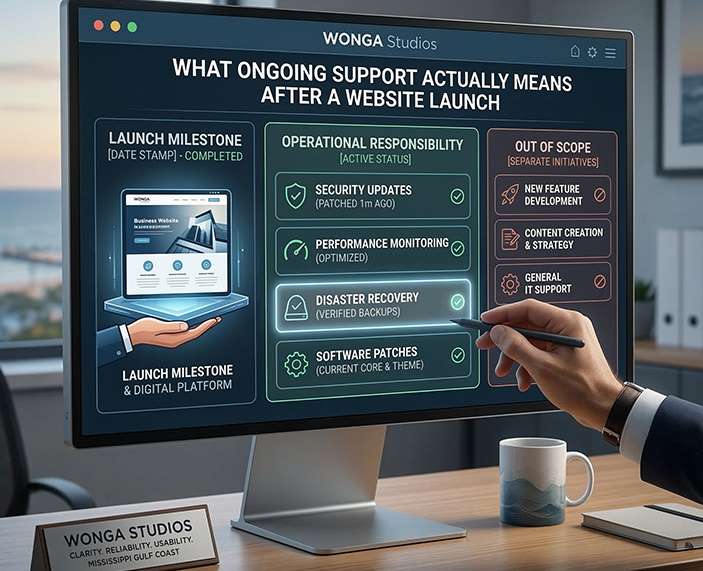
Ongoing support, particularly in the context of high-functioning business sites, primarily consists of technical maintenance and preventative care. This work is often invisible when executed correctly but immediately noticeable if neglected. These tasks are critical for professional services firms whose online reputation directly impacts their client acquisition in competitive markets like Biloxi or Gulfport. The technical aspects of this maintenance are typically bundled within Managed Web Hosting, which emphasizes technical stability rather than merely selling server space.
Preventative Security and Core Application Updates
The core infrastructure of any modern website relies on software that must be regularly updated. For sites built on the WordPress ecosystem, this involves patching the WordPress core software, ensuring the theme (such as Avada) is current, and updating every individual plugin. These are not aesthetic changes; they are essential security measures. Vulnerabilities in outdated software are the primary entry point for malicious attacks that can deface a site, steal client information, or inject harmful scripts.
Professional offices, which often handle sensitive client data, cannot afford these risks. Ongoing support provides the structured cadence for evaluating these updates, testing them in a controlled environment when necessary, and implementing them safely. A critical component of this process is checking for compatibility after an update is applied. Simply clicking “update” is insufficient for a business system. Verification ensures that an update to one plugin does not inadvertently disable essential functionality, which is the definition of maintaining Website Foundations.
Comprehensive Disaster Recovery and Business Continuity
Data loss can occur from multiple vectors, including technical failure at the server level, a malicious hack, or critical user error. While modern hosting facilities are robust, relying on a single source of data is a business risk. Ongoing support must include a robust backup strategy that is monitored for success and tested for restorable integrity.
This approach requires multiple layers: local backups, which provide quick restoration for minor issues, and redundant, off-site cloud backups to protect against catastrophic facility failure. For a professional services business, such as a law firm, a functional backup means that if a critical error occurs during a client review period, the site can be restored rapidly to its last known stable state. A strong support agreement pre-defines this recovery time objective, ensuring business operations are not significantly impacted by technical interruptions.
System and Performance Monitoring
Operational stability requires visibility into how the technical system is performing. Ongoing support involves monitoring server health and application uptime. If a service becomes unresponsive, professional monitoring tools immediately alert the principal so action can be taken, often before the business owner or their clients even realize an issue exists. Performance monitoring also identifies slowdowns caused by database bloating or inefficient resources, which, if left unchecked, degrade the user experience and can negatively impact Search & Visibility. For professional offices in South Mississippi aiming for consistent lead generation, a fast, reliable site is an operational necessity.
What Ongoing Support Explicitly Does Not Include
Just as it is essential to define what a support agreement includes, it is equally important to define what is excluded. Standard support is focused on maintenance, not evolution. It is not a design retainer or a new development budget. The most common source of friction between a business and a studio stems from assuming maintenance covers all requests related to the website. Understanding these boundaries ensures that professional offices can properly budget for future enhancements, often utilizing the Services Overview to plan for new initiatives.
New Feature Development and Technical Modifications
A support agreement focuses on the health of the existing, approved system. It does not include developing new sections, adding non-trivial functionality, redesigning page layouts, or altering the core structural components of the site. For instance, if a medical practice wants to integrate a new third-party appointment booking system six months after launch, this constitutes a new project or a significant add-on request. A support agreement would cover the maintenance of the *existing* systems, but the discovery, integration, configuration, and testing of the *new* system would fall outside that scope and require a separate scoping exercise and budget.
Substantive Content Creation and Branding
Content creation is a distinct discipline from technical maintenance. Standard ongoing support does not include writing new blog posts, drafting page copy, source photography, or creating graphic design assets. These fall under Content Strategy or marketing efforts. For professional offices that engage WONGA Studios for ongoing content development, this work is typically scoped through distinct retainers where content is drafted, potentially using AI-assisted tools for initial research and structure, but always heavily reviewed and edited by human principles to ensure it meets business and branding standards. Support, in the technical sense, focuses on the container (the website structure), not the content placed within it.
Generalized IT Support and Training
For Mississippi Gulf Coast businesses, technical support is often broadly categorized, but it must be clearly differentiated. Ongoing web support pertains specifically to the live website and its hosting environment. It does not include internal IT support for the business office, such as configuring employee email clients, setting up office routers, managing on-site servers, or troubleshooting workstation software issues. These essential services fall under the separate category of dedicated IT Support, which requires a different type of technical specialization and is managed outside the scope of web support.
Structuring Support for Predictable Success
The goal of defining ongoing support is to create operational predictability for both the professional office and the creative and technical studio. For businesses in Long Beach, Gulfport, and Biloxi, predictability translates directly to financial and operational stability. When the scope of support is clearly understood, the business decision-maker can rely on the principal-led execution to maintain the Website Foundations without worrying about technical decay or sudden cost overruns. This disciplined approach ensures that the initial scoped investment remains a functional, reliable tool for the long-term success of the business.
Let’s Build Something That Works for Your Business
Let’s Build Something That Works for Your Business
WONGA Studios brings years of experience across web design, motion graphics, video production, and practical IT support. We work with proven platforms and tools to create reliable, accessible solutions that support real business goals – without unnecessary complexity.